
How to Choose a Web Development Company in Islamabad: A Buyer’s Guide
Choosing a web development company in Islamabad: a buyer's guide
A website is usually the first thing a customer checks before they call, visit or pay. Yet many businesses in Islamabad pick a web development company on gut feeling, a cheap quote or a nice-looking demo, and only discover the problems later: a site that is slow on mobile data, a domain registered in someone else's name, or a developer who stops answering after launch.
This guide comes from our web team, which works from our office in G-9 Markaz. It walks through the decisions and checks we would make if we were the ones hiring a web development company in Islamabad. Use it as a checklist, whether you end up working with us or with anyone else.
Quick answer
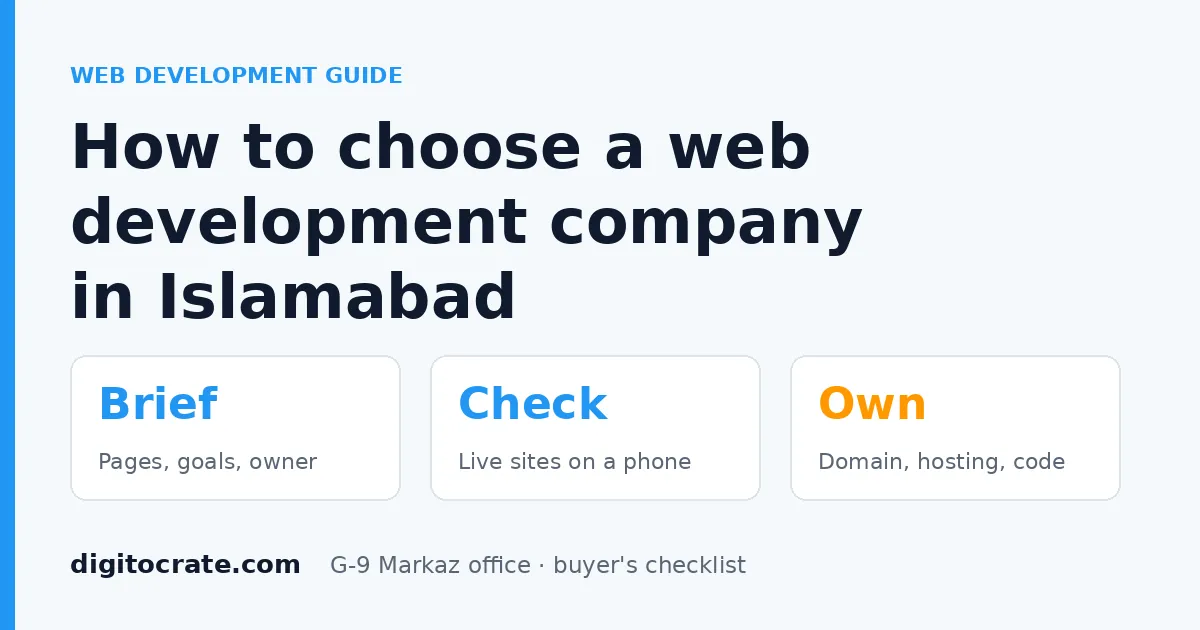
Write a one-page brief, shortlist two or three providers, open their live websites on your own phone, and ask who will own the domain, hosting and code. Choose the team that explains its process and fees clearly in writing, builds SEO basics in from day one and offers support after launch. Treat guaranteed rankings, vague quotes and "we keep the login" as reasons to walk away.
Step 1: Write a short brief before you contact anyone
You do not need a technical specification. You need one page that answers a few plain questions, so every company quotes for the same thing:
- Goal. What should the website do? Bring WhatsApp enquiries, take online orders, show a portfolio, recruit staff?
- Pages. List the pages you expect: home, about, each main service, contact, maybe a blog. A rough count is enough.
- Features. Online payments, booking, a product catalogue, Urdu and English content, a client login?
- Content. Will you supply the text and photos, or do you need them written and shot?
- Who edits. Will your team update the site often, or only a few times a year?
- Timing. Is there a real deadline, such as a shop opening or a trade show?
A brief like this protects you. When three quotes are based on the same list, you can compare them honestly instead of comparing a five-page site against a twenty-page one.
Step 2: Understand the kinds of providers
When people search for a web development company in Islamabad, they find very different kinds of businesses behind the same words. Each can be the right choice.
Freelancers
One person who designs and builds. Often flexible and quick for small sites. The risk is continuity: if that person is ill, busy or moves on, your site has no one looking after it. Ask what happens if they are unavailable.
Small studios
A small team with a designer, a developer and someone who manages the project. You usually get more structure, written processes and someone to call when things break.
Full-service agencies
Teams that also handle SEO, content writing and social media. Useful when the website is part of a wider marketing plan, because one team is responsible for both the site and the traffic it gets. Make sure you are not paying for services you do not need.
Step 3: Choose the platform for your situation, not theirs
A good company recommends a platform based on how you work, and explains why. A weak one uses the same tool for every client because it is the only one it knows.
- WordPress suits teams that publish often and want to edit everything from a dashboard. The trade-off is maintenance: the core, theme and plugins all need regular updates, and outdated plugins are a common cause of hacked sites.
- Next.js suits service businesses, law firms, clinics and publishers where speed, security and Google visibility matter most. Pages are built ahead of time, so there is no plugin to patch and very little to break. We explain the trade-offs in our WordPress to Next.js migration guide.
- Hosted store builders can suit small shops that want to start selling quickly, as long as you are comfortable with their monthly fees and limits.
Ask every company: "Why this platform for us, and what will it need from us every month?" The answer tells you a lot about how they think.
Step 4: Check their work properly
Screenshots in a portfolio prove very little. Ask for links to live websites they built, then check them yourself:
- Open them on your own phone, on mobile data rather than office Wi-Fi. Most of your visitors in Pakistan will see your site this way.
- Run a few through Google PageSpeed Insights. It is free. Look at the mobile result, not just desktop.
- Tap the buttons. Do the WhatsApp and contact links work? Do forms send? Are there broken pages?
- Check that the sites are still live and maintained. A portfolio full of expired domains is a warning.
- Ask to speak to a past client if the project is large. A confident company will usually arrange it.
Step 5: Settle ownership before you pay anything
This is the step most businesses skip, and the one that causes the most pain later. Agree in writing that:
- The domain name is registered in your name (or your company's), with login details shared with you.
- You have your own hosting account access, or a clear written arrangement if the company hosts it for you.
- You receive admin access to the website and, for custom builds, a copy of the code or access to the code repository.
- Google Search Console, Google Analytics and your Google Business Profile are set up under your own Google account, with the developer added as a user.
If a company refuses any of these, think carefully. You should be able to change providers in the future without rebuilding from scratch.
Step 6: Make sure SEO basics are built in, not added later
A beautiful site that Google cannot read will not bring enquiries. Ask whether the build includes clean URLs, a unique title and meta description for every page, an XML sitemap, correct headings, image alt text, fast loading on mobile and Search Console verification at launch.
If you are replacing an old website, ask how they will handle 301 redirects from old addresses to new ones. Skipping redirects is one of the most common reasons a business loses its Google traffic after a redesign. After launch, a simple SEO audit will show whether the basics are in place. If you also need ongoing SEO, our guide on choosing an SEO company in Islamabad covers what to ask.
Step 7: Compare fees on the same scope
Website fees in Islamabad vary widely, and the cheapest quote is rarely the cheapest site over two or three years. The main things that drive fees are:
- the number of pages and how many unique layouts they need;
- features such as e-commerce, payments, booking or multiple languages;
- who writes the content and supplies the photos;
- the platform, and how much maintenance it will need;
- yearly costs: domain, hosting, renewals and support.
Ask for a written quote that lists what is included, what is not, and what you will pay each year after launch. For reference, our own packages are Starter Rs 25,000, Business Rs 35,000 and Online Store Rs 50,000, each including a domain and a year of hosting, with annual renewals of Rs 15,000, Rs 20,000 and Rs 25,000. See the business website package for what each plan includes, and our breakdown of website design cost in Pakistan for custom builds and migrations.
Step 8: Ask about the process and what happens after launch
A clear process usually looks like this: brief and call, sitemap and page plan, design, build, content, testing on real phones, launch, then handover. Ask who your day-to-day contact will be and how many rounds of changes are included.
Then ask what happens after launch. Who applies updates, takes backups and fixes things if the site goes down? Is that included for a period, or is it a separate monthly arrangement? For WordPress sites in particular, ongoing WordPress maintenance matters as much as the build itself.
Questions to ask every web development company
- Which platform do you recommend for us, and why?
- Can I see three live websites you built in the last year?
- Will the domain, hosting and Google accounts be in my name?
- What exactly is included in the fee, and what will I pay every year?
- How do you handle SEO basics and redirects from my old site?
- How many rounds of changes are included?
- Who looks after updates, backups and security after launch?
- How will my team edit text and photos once the site is live?
Red flags to watch for
- Guaranteed first-page rankings. No developer controls Google's results.
- A one-line quote with no list of pages, features or yearly costs.
- Refusing to register the domain in your name or to share logins.
- No live examples, only screenshots or templates.
- Pressure to pay everything up front before any design is shown.
- No plan for after launch. Websites need care, just like any other business asset.
A simple checklist to finish
- Write a one-page brief with goals, pages, features and timing.
- Shortlist two or three providers and send each the same brief.
- Test their live websites on your phone and in PageSpeed Insights.
- Agree ownership of the domain, hosting, code and Google accounts in writing.
- Confirm SEO basics and redirects are part of the build.
- Compare written quotes, including yearly costs.
- Agree the process, number of revisions and support after launch.
Planning a new website or a redesign? Send us your brief, or just your current website address, on WhatsApp. Our web team in G-9 Markaz will reply with the platform we would recommend and a clear written fee. Message us on WhatsApp.
Frequently asked questions
How long does it take to build a business website?
A small package website can be ready in a few working days once the content and photos are supplied. Our package websites go live 2 to 3 working days after we receive your details, pictures and product list. Larger custom sites and online stores need a timeline agreed after scoping.
Do I need a company based in Islamabad?
Not necessarily, but a local team is easier to meet, understands how people in the city search and buy, and can help with local details such as your Google Business Profile and sector-based location pages. What matters most is clear communication and a written agreement.
Should I choose WordPress or Next.js?
Choose WordPress if your team edits the site daily and needs a familiar dashboard. Choose Next.js if speed, security and low maintenance matter more. A good company will recommend one based on how you work and explain the trade-offs.
Who should own my domain and hosting?
You should. Register the domain in your own or your company's name and keep the login details. That way you can change developers in future without losing your website or email.
Does a new website include SEO?
It should include the technical basics: clean URLs, titles, meta descriptions, a sitemap, fast loading and Search Console setup. Ongoing SEO, such as new content and local optimisation, is usually a separate service.